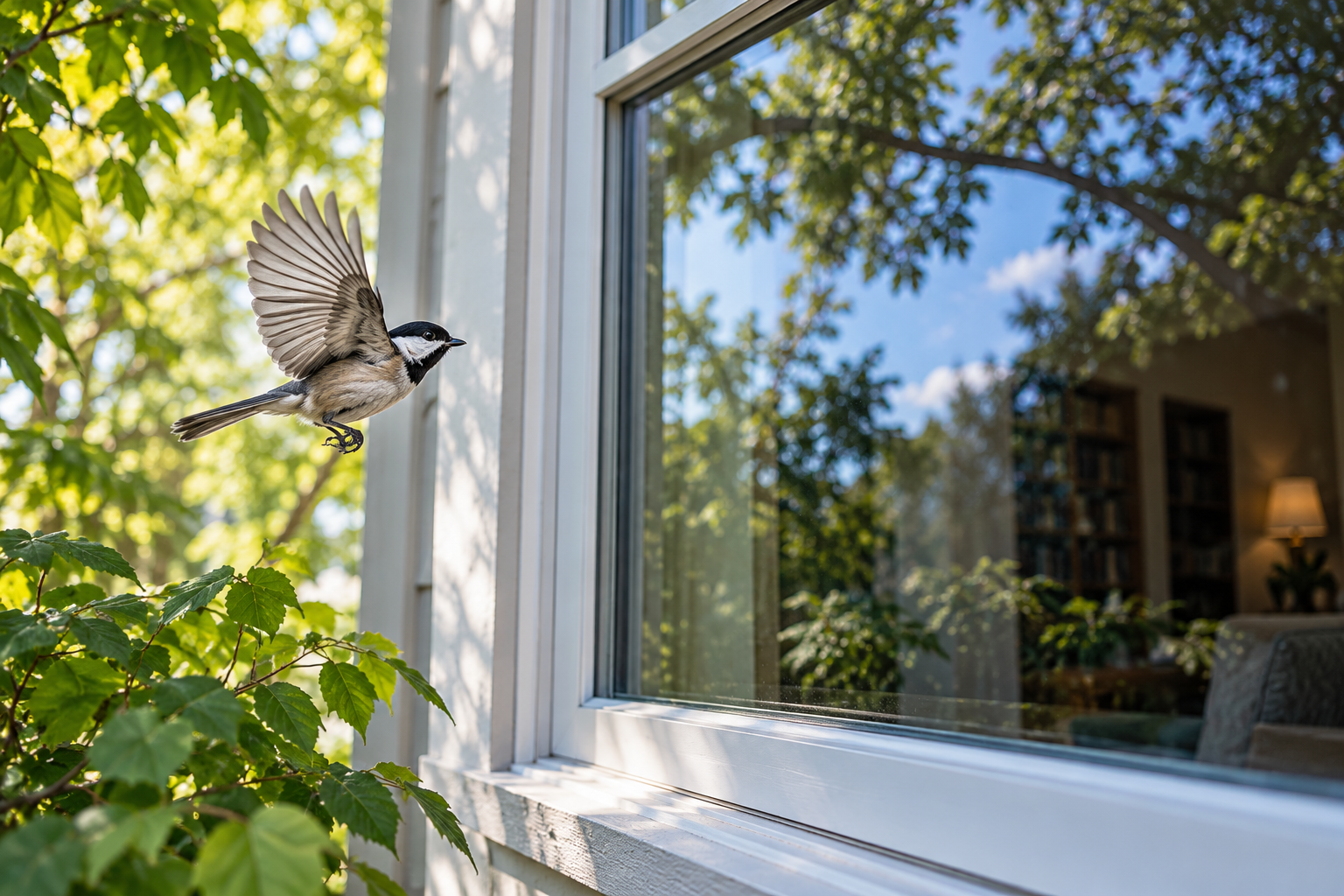
Stand outside a window in daylight and move a few steps sideways. A pane that let you see into the room a moment ago may now hold the outline of a tree. From another angle, the branches disappear and the far side of the room comes back. The glass has not moved. The scene available to an approaching bird has.
Birds fly toward places that look open and toward features that ordinarily belong to usable habitat. Glass can present both: a reflection of leaves and sky on its surface, or a view through the pane to vegetation and light beyond it. The solid barrier supplies too little warning on the path between the bird and that apparent destination. This is what people mean when they say a window “confuses” a bird. The phrase describes a dangerous mismatch between visual information and physical space; it does not tell us exactly what an individual bird thought.
The distinction between reflection and see-through glass matters. A darkened room behind a pane can strengthen the reflected outdoor scene. A clear bus shelter may show the street and trees through its opposite walls. In a 2017 study of 18 glass-walled bus shelters in Stillwater, Oklahoma, Christine Barton and colleagues found more fatal collisions at shelters with more glass. They also observed a robin inside one shelter repeatedly flying into a transparent wall while trying to leave. That incident makes the see-through problem concrete, though one bird's behaviour cannot explain all shelter strikes. The study's larger result is an association between glass area and collisions in one city, not a measurement of every bird's visual experience.
A reflection changes while the wall stays still
The appearance of a pane depends on outdoor light, indoor light, what stands behind the glass and the angle from which it is approached. A person assessing a risky window from a chair indoors is seeing a different surface from the one a bird sees outside. A sunlit tree can appear across a window when the room is dim; later, a different angle may make a clear path through two panes look possible. The same building can present different visual hazards through the day.
That shifting view is hard to capture from the evidence most collision surveys collect: a bird found below a window, or a mark on the glass. Brendon Samuels and colleagues placed cameras at a residential window and recorded 38 approaches over two years: 29 collisions and nine near-misses. Birds arrived at different angles and speeds. Most collisions went unnoticed by the occupants, and many birds flew away immediately; the cameras could not establish those birds' later condition. The videos show how much of the event a carcass search or an indoor observer can miss. They also leave the question of exactly what visual feature each approaching bird followed open.
Field evidence does give good reason to treat strongly mirrored glass with care. In a two-year University of Utah study, Barbara Brown and colleagues monitored eight buildings across fall and winter seasons. Mirrored windows were associated with more collisions, while bird-friendly glass was associated with fewer in their models. Winter strikes also clustered around fruiting pear trees, especially among Cedar Waxwings. A window's setting matters: the tree can draw birds into the area at the same time as the glass presents a misleading scene or an unseen barrier.
Yet the simple claim that a brighter reflection always causes more strikes fails an experimental test. Lauren Emerson and colleagues varied the lighting around clear windows in a flight tunnel and tracked domesticated Zebra Finches. They expected a stronger reflection to increase collision risk. Under bright midday exterior light, the more reflective condition was associated with fewer predicted collisions. The morning result did not provide strong support for an increase. The authors proposed that features of light beyond brightness, perhaps polarization, may matter, but did not establish that explanation. A small flight experiment with one species cannot overturn every field observation about mirrored façades. It does show why reflectivity alone is an incomplete hazard score.
Make the barrier legible
There is a practical point beneath this uncertainty. A bird needs a signal on the flight path that indicates a solid plane. A decorative silhouette in one corner leaves most of a large pane visually unchanged. Repeated marks across the outside surface interrupt reflected or transmitted scenery and make the plane itself more apparent.
The outside placement has experimental support. In John Swaddle and colleagues' 2023 flight trials, 72 domesticated Zebra Finches encountered double-glazed windows with one of two films on either the exterior or interior surface. A short-wavelength film on the exterior increased measured avoidance by about 47% compared with untreated windows; a second film showed a smaller, statistically less secure increase. Neither film produced a detectable avoidance benefit when placed inside. A mist net prevented actual impacts, so those figures describe predicted collision paths in an aviary, not a measured reduction in deaths at homes. The result still explains why a pattern hidden behind the reflective outer surface may do little for a bird approaching from outside.
Field tests give the treatment a more direct check. Georgia Riggs and colleagues compared glass bus shelters before and after small, closely spaced exterior markers were installed, with untreated shelters for comparison. Collisions fell at treated shelters even as they rose at untreated ones; the team estimated a 64% reduction in annual collisions across the city's shelters from treating half of them. The estimate belongs to those shelters and that marker layout, not every window everywhere. The Utah study likewise found a larger decline in strikes on newly marked glass than in comparison areas at two buildings. These real places matter because a bird in the street can turn away, approach from another angle, or meet weather and light that an aviary cannot reproduce.
For a household window, the US Geological Survey recommends a close pattern, about two inches by two inches, on the outside of the glass. Dots, lines, a cord curtain or temporary paint can serve that purpose if they cover the whole hazardous pane densely enough. The exact design must remain visible against whatever the pane reflects or shows through it. One isolated sticker gives the bird no reason to avoid the broad clear space around it.
The first step is to look from outdoors, from several approach angles and at different times. Notice where foliage appears in the reflection, where a view passes through a corner or a second window, and which panes sit beside places birds use. Then make those panes visibly continuous barriers. Record any future strikes, but do not treat a quiet morning as proof of safety: the backyard cameras caught collisions that people inside never saw. A safer window is one whose surface announces itself along the bird's route, even as the sky and trees around it change.

A thought worth keeping?